
River Safari Sri Lanka: Mangroves & Crocodiles
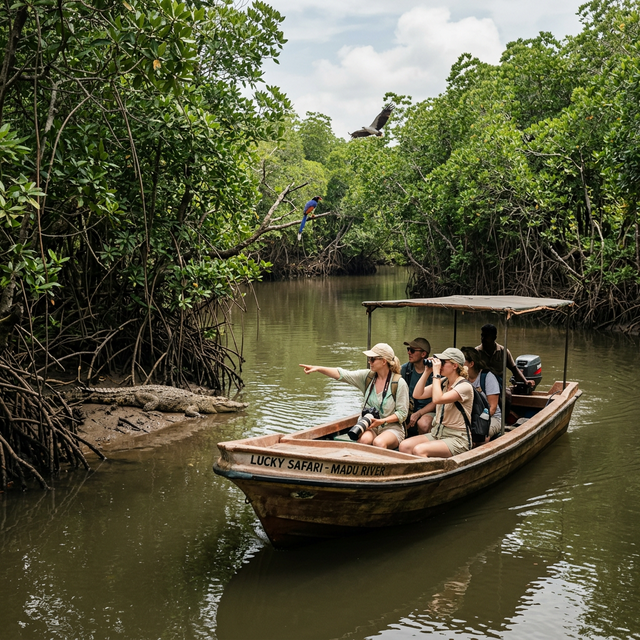
When people think of safaris in Sri Lanka, they picture dry scrubland and jeeps bouncing after elephants. However, the island's vast network of coastal estuaries offers a completely different, much calmer wildlife experience: the river safari in Sri Lanka.
The Madu River Estuary
Located near Balapitiya (on the southwest coast), the Madu River is a complex ecosystem of dozens of small islands and dense, tangled mangrove forests.
- You hire a small motorized wooden boat to glide silently through deep, dark tunnels formed by the overhanging mangrove roots.
- Wildlife sightings are almost guaranteed: massive water monitor lizards sunning themselves on branches, kingfishers diving for fish, and occasionally, estuarine crocodiles lurking on the muddy banks.
Cultural Stops Along the Water
These boat tours are not purely natural. They often include stops at small river islands where locals demonstrate traditional cinnamon peeling techniques or where you can visit centuries-old Buddhist temples completely isolated from the mainland.
A Perfect Afternoon Activity
A river safari usually takes about 2 hours, making it the perfect activity when you want a break from the intense midday sun at the beach. Instead of trying to flag down a tuk-tuk, pre-book a round-trip taxi from your hotel in Hikkaduwa or Bentota to the river launch site for a stress-free afternoon.
Book Your Reliable, Fixed-Rate Sri Lanka Airport Taxi Now
Travel with Peace of Mind!
Book Now: +94 765 603 961Best River Safari Locations in Sri Lanka
Sri Lanka's river safari scene has grown significantly in recent years, with several rivers offering distinct wildlife and experiences. The Madu River lagoon near Balapitiya (between Colombo and Galle) is the most developed and accessible — a network of 64 islands covered in mangrove canopy, with monitor lizards basking on branches, kingfishers darting across the water, and cinnamon and fish processing operations visible from the boat. The safari takes 1.5–2 hours by motorised wooden boat and costs Rs 2,500–4,000 per person.
The Bentota River is another popular option, offering a longer safari through mangroves, past turtle hatcheries, and into small lagoon channels. Madu Ganga (Madu River) is designated a UNESCO Wetland of International Importance — one of only three in Sri Lanka. The Nilwala River near Matara and the Kirala Kele wetland near Matara are less visited alternatives with excellent bird life but fewer tour operators.
Wildlife You Can Expect to See
River safaris in Sri Lanka's southwest offer rewarding wildlife even for visitors who have done game drives in Africa or India. The star sightings at Madu River are the water monitor lizards — often 1.5–2 metres long — that lounge on mangrove roots immediately beside the boat. They are completely unafraid of tourists, having lived alongside boat traffic for decades.
- Water monitor lizard: Virtually guaranteed at Madu River — look for them on low branches
- Purple-faced langur: Endemic Sri Lankan monkey, often spotted in mangrove trees
- Kingfishers: Common kingfisher, stork-billed, and pied varieties
- Black-crowned night heron and grey heron: Fishing along the banks
- Brahminy kites: Large raptors that swoop for fish — dramatic to watch
- Cinnamon bark peeling: Not wildlife but a fascinating cottage industry visible on some islands
How to Get to Madu River and Bentota
The Madu River entrance at Balapitiya is approximately 85 km south of Colombo — under 2 hours via the Southern Expressway. Bentota is 65 km from Colombo (1.5 hours by expressway). Both are easily combined with a day trip from Colombo to Bentota that includes a river safari in the morning and beach time in the afternoon. Our taxis can drop you at the river safari booking point, wait during the safari, and continue to your beach hotel afterwards. For flexible south coast itineraries, call +94 765 603 961.
Best Time to Visit for River Safaris
Madu River and Bentota River safaris operate year-round, but the experience varies with the season. The dry southwest season (December to April) brings the clearest water and best light for photography, with monitor lizards sunbathing reliably on exposed roots. The wetter months (May to October) see higher water levels in the mangrove channels, allowing boats to access narrower, more atmospheric passages that are unreachable in dry season. Bird life is excellent year-round; nesting activity peaks between August and October.
River safari operators work in the early morning and late afternoon — the midday period is hotter and wildlife is less active. A 7 AM start at Madu River gives you the best light and the greatest chance of seeing monitors basking before the heat drives them into shade. Most operators can arrange early morning pickups from nearby guesthouses and hotels.
Mangrove Ecosystem — Why It Matters
Sri Lanka's coastal mangrove forests are among the most biodiverse habitats on the island, providing nursery grounds for commercially important fish species, protecting coastlines from erosion and storm surge, and sequestering carbon at rates three to five times higher than tropical rainforests per hectare. The Madu Ganga mangrove system alone covers 915 hectares and supports 303 plant species, 248 animal species, and roughly 2,000 families who depend on the lagoon for their livelihoods.
Tourism at Madu River is managed to minimise impact — boat engines are restricted in the inner channels and visitor numbers are limited at sensitive nesting sites. The entrance fee collected from safari guests funds conservation work by the Central Environmental Authority. Choosing operators who follow these guidelines rather than unofficial 'shortcut' boats that bypass fees is the most practical way tourists can support the system. Ask your operator which organisation manages their licence.