
Udawalawe Elephant Safari: Guaranteed Sightings
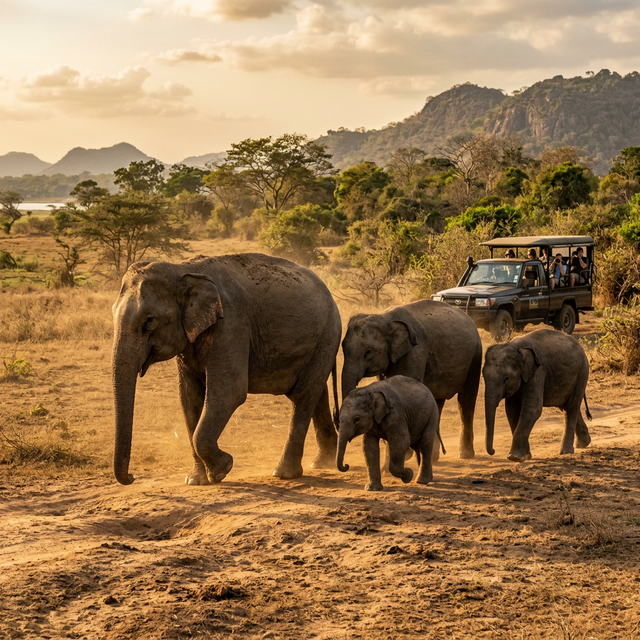
If seeing elephants in the wild is at the top of your Sri Lanka bucket list, skip the crowds of Yala and head straight to Udawalawe National Park. Created to provide a sanctuary for wild animals displaced by the construction of the Udawalawe Reservoir, this park is functionally an elephant paradise, offering what many consider to be guaranteed daily sightings.
Why Udawalawe is Different
Unlike Yala, which features thick, scrubby jungle, much of Udawalawe consists of open grasslands and light forest surrounding the massive central reservoir. This open terrain means visibility is excellent.
- The Elephant Population: The park sustains a permanent herd of around 500-600 elephants. It is incredibly common to see entire families—from massive matriarchs to tiny, playful calves—crossing the dirt tracks right in front of your jeep.
- Beyond Elephants: While leopards reside here, they are very rarely seen. However, the park is fantastic for spotting water buffalo, crocodiles, monitor lizards, monkeys, and a spectacular array of birds of prey, including the Changeable Hawk-eagle.
The Elephant Transit Home (ETH)
Located just outside the park gates is the Elephant Transit Home, supported by the Born Free Foundation. Unlike Pinnawala, this is a genuine conservation facility that rehabilitates orphaned elephant calves with minimal human contact before releasing them back into the wild. Visiting during the public feeding times (from a viewing platform) is a heartwarming and ethical way to see these animals.
Safari Logistics
Udawalawe is a year-round destination. While the dry season (May to September) concentrates animals around water sources, the lush green landscape of the wet season offers its own beauty.
- Timing: As with all safaris, early morning (6:00 AM) or late afternoon (3:30 PM) are the best times, as the animals are most active during the cooler parts of the day.
- Booking Jeeps: Jeeps can be easily hired at the park entrance or organized through your guesthouse in the nearby town of Udawalawa.
Udawalawe is often visited as a stopover between the hill country (Ella) and the southern beaches. Rather than dealing with complex bus routes, many travelers opt to book an intercity taxi, allowing them to depart Ella in the morning, do an afternoon safari in Udawalawe, and be dropped off at their beach hotel by evening.
Book Your Reliable, Fixed-Rate Sri Lanka Airport Taxi Now
Travel with Peace of Mind!
Book Now: +94 765 603 961Best Time to Visit Udawalawe for Elephant Sightings
Udawalawe National Park is one of the few places in Asia where large elephant herds — sometimes 30 to 50 animals — can be reliably seen from a vehicle on an afternoon game drive. The park's open scrub landscape and the Udawalawe reservoir mean elephants are visible year-round, unlike forested parks where animals hide in dense vegetation. The best sightings are typically at dawn (6–9 AM) and dusk (4–6 PM) when elephants congregate near water.
Udawalawe is one of Sri Lanka's more reliable parks precisely because it lacks the deep forest cover of Sinharaja or Knuckles. The reservoir created by the Udawalawe Dam has permanently altered the landscape in favour of grassland and scrub — elephant habitat. The park is home to an estimated 600 resident elephants. During the dry season (May to September), when smaller water sources dry up, elephant concentrations around the reservoir reach their peak.
Safari Logistics — What You Need to Know
All game drives in Udawalawe must be conducted in a park-approved jeep with a registered guide. Self-driving is not permitted. Jeep hire typically costs Rs 6,000–8,000 for a half-day drive (3 hours), not including the park entrance fee of Rs 4,500 per adult foreigner. Sunrise drives depart around 6 AM and return by 9:30 AM; sunset drives run from 3:30 PM to 6:30 PM. Full-day drives covering both sessions cost Rs 15,000–18,000 for the jeep.
The Elephant Transit Home, run by the Department of Wildlife Conservation just outside the park, rehabilitates orphaned elephant calves before releasing them into the wild. Feeding sessions where young elephants drink from giant milk bottles take place at 6 AM, 9 AM, noon, 3 PM, and 6 PM — any of these is worth a 30-minute detour from the main park.
- Carry cash — entrance fee kiosks may not accept cards
- Binoculars significantly improve bird-watching (200+ species recorded)
- Wear neutral colours — bright clothing can disturb wildlife
- Early morning drives are cooler and more productive than midday
Getting to Udawalawe from Colombo or the South Coast
Udawalawe is approximately 165 km from Colombo (3.5 hours via the Southern Expressway to Embilipitiya) and 110 km from Galle (2.5 hours). From Ella, Udawalawe is just 65 km — a popular combination for travellers doing both the hill country and the south. A private taxi from Colombo towards the south passing through Udawalawe is the most flexible option, allowing an early morning park entry followed by onward travel to Mirissa or Tangalle the same day. Call +94 765 603 961 to arrange a multi-stop south coast itinerary.
Combining Udawalawe with Mirissa or Tangalle
Udawalawe's location on the southern highway makes it ideal for combining with a south coast beach stay. After a 6 AM game drive, you can be on the road by 10 AM and reach Mirissa (55 km east) by noon — a natural progression from wildlife to beaches. Alternatively, Tangalle is 65 km to the east, with some of Sri Lanka's most unspoiled beaches and boutique guesthouses. This Udawalawe → Mirissa → Galle route, done in 3–4 days, covers wildlife and the best of the south coast without doubling back.
Our south coast transfers connect all these destinations. A Colombo to Hambantota region transfer passing through Udawalawe is a popular itinerary — guests do the morning safari, we collect them afterwards and continue towards the beach. Call +94 765 603 961 to plan a multi-stop south coast day.