
Hiking Adam's Peak: The Midnight Pilgrimage
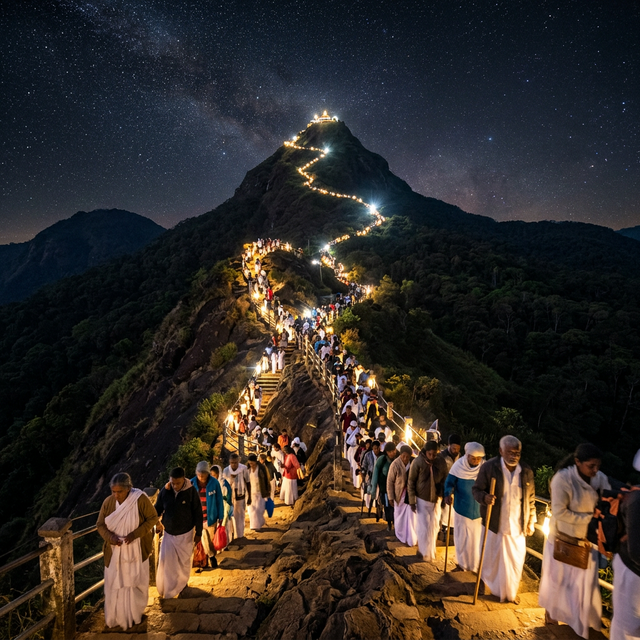
Climbing Adam’s Peak (Sri Pada) is not a wilderness hike; it is a profound cultural immersion. Rising dramatically from the central massif, it is a sacred pilgrimage site for Buddhists, Hindus, Muslims, and Christians alike. Hiking Adam's Peak is an exhausting but spiritually uplifting experience.
The 5,500 Steps
Do not underestimate the physical challenge. The most popular route from the village of Dalhousie consists of roughly 5,500 uneven stone steps. It is a grueling, relentless staircase that punishes your calves on the way up and your knees on the way down.
The Midnight Start
The goal is to reach the summit by dawn to witness the spectacular sunrise and the massive triangular shadow the mountain casts over the jungle below.
- Because the climb takes 3 to 5 hours depending on fitness and crowds, most hikers begin their ascent around 1:00 AM or 2:00 AM.
- During the pilgrimage season (December to May), the entire pathway is strung with lights, and small tea stalls line the route, giving it a vibrant, festival-like atmosphere.
Reaching Basecamp
The logistics of getting to Dalhousie are complicated, as it is located at the end of a winding, dead-end mountain road without a train station. Taking a public bus from Hatton late in the evening is miserable. Ensure you arrive well-rested for your midnight hike by booking a direct private taxi to your guesthouse at the base of the mountain.
Book Your Reliable, Fixed-Rate Sri Lanka Airport Taxi Now
Travel with Peace of Mind!
Book Now: +94 765 603 961The Night Hike to Adam's Peak — What You Need to Know
Most pilgrims and hikers climb Adam's Peak at night to reach the summit for sunrise. The trail from Dalhousie is illuminated by electric lights along the entire 7 km staircase route, so hiking in darkness is not the challenge it might sound. The climb takes most moderately fit adults 2.5 to 4 hours at a steady pace; the descent 1.5 to 2.5 hours. Total round trip is approximately 14 km with an elevation gain of 1,200 metres — genuinely strenuous but achievable without technical climbing experience.
The season runs December to May, when weather is clearest. January and February see peak pilgrim traffic — weekends can bring 10,000+ people simultaneously on the trail, creating slow-moving queues near the summit. Weekday climbs during season are significantly less crowded. Outside season (June to November), the trail is open but the summit is almost always cloud-covered.
Essential Gear for the Climb
Adam's Peak demands more preparation than many visitors expect. The 5,500 stone steps are steep and relentless — your knees feel the descent harder than the ascent. Proper footwear is essential; sandals are dangerous on wet steps. The summit temperature in January drops to 5–10°C even when the base is 25°C — a windproof layer is critical.
- Footwear: Trail shoes or sturdy sneakers — no sandals or flip-flops
- Clothing: Light base layer plus a windproof jacket — it is genuinely cold at the top
- Water: Carry 1.5–2 litres; stalls along the route sell drinks at slightly inflated prices
- Snacks: Energy bars or nuts — you will be hungry long before the summit
- Cash: Entry fee Rs 400 for foreigners payable at the gate; all stalls are cash only
- Headlamp: Useful even with the lit stairway, especially if you rest off the main path
Getting to Dalhousie (Adam's Peak Trailhead)
The Dalhousie trailhead is approximately 170 km from Colombo (4 hours by road), 75 km from Kandy (2.5 hours), and 55 km from Ella (1.5 hours). Public buses from Kandy operate during the season but infrequent schedules make night hiking impractical without private transport. Most hikers take a private taxi to Dalhousie for an 11 PM or midnight departure, with the driver waiting in the village and collecting them after descent — typically by 8–9 AM. Our Colombo to Ratnapura and hill country transfers connect with Dalhousie. For overnight waiting transfers with a confirmed fixed rate, call +94 765 603 961.
Safety on the Trail
Adam's Peak is a well-maintained, heavily used trail with no technical climbing sections — but it demands respect. The steps are steep and can be wet and slippery after rain. The biggest risks are falls on the descent (when tired legs and slick steps combine) and altitude-related discomfort near the summit (2,243m). Dehydration is common because hikers underestimate fluid needs on a cool night — drink consistently throughout the climb rather than waiting until thirsty.
Facilities on the trail include public toilets at several points (Rs 20–50 to use), tea stalls selling hot drinks and snacks every 30 minutes of climbing time, and a first aid post near the summit managed by volunteers during the pilgrimage season. Mobile coverage on Dialog and Mobitel extends to the summit. Emergency contact numbers: Police 119, Ambulance 110.
- Do not start the descent immediately after sunrise — wait 30 minutes for warmth and visibility to improve
- If you feel altitude sickness (headache, nausea, dizziness), descend immediately — do not push through
- Keep children close on the steep upper sections where the crowd is densest
- Allow extra time — the summit crowd at sunrise means slow movement even on the steps